
Are your thoughts holding you back?
If you’ve ever told yourself, “I’m not good enough” or “I’ll never have what I want,” you’ve experienced limiting beliefs in action.
These silent blockers shape your reality and keep you stuck.
But here’s the truth: you can change them.
This guide will help you understand what limiting beliefs are, where they come from, and how to overcome them step-by-step so you can finally manifest what you truly desire.
What are Limiting Beliefs?
Limiting beliefs are deeply held assumptions that prevent you from pursuing or achieving what you want.
They often feel like truths—but they’re just thoughts that got repeated so often they became automatic.
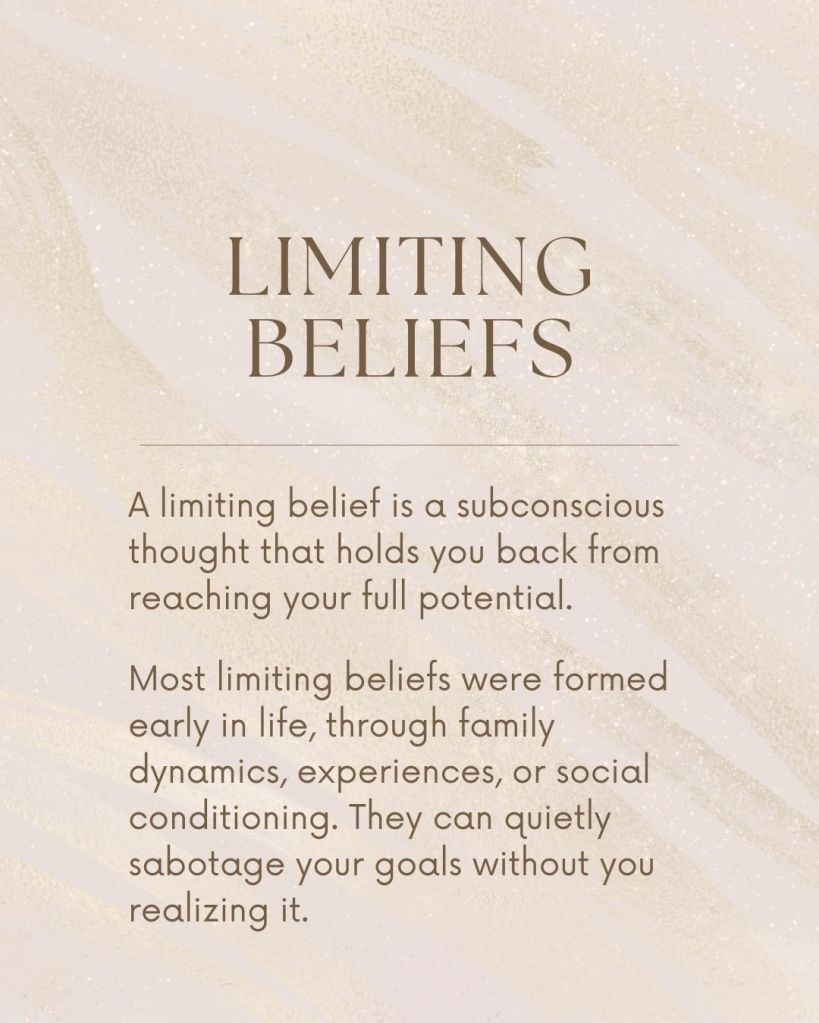
Limiting beliefs definition: A limiting belief is a subconscious thought that holds you back from reaching your full potential.
Most limiting beliefs were formed early in life, through family dynamics, experiences, or social conditioning.
They can quietly sabotage your goals without you realizing it.
You might not even be aware that a belief is limiting you until you try to change or grow—and feel an internal block pushing back.
Examples of Limiting Beliefs
Here’s a limiting beliefs list to help you recognize your own:
- I’m not smart enough
- I don’t deserve love
- I’ll never have enough money
- I’m too old to change
- Success isn’t meant for people like me
- I always mess things up
- No one cares what I have to say
- It’s too late for me
- I’m bad with money
- I’m just not a lucky person
These are self-limiting beliefs—false ideas that limit what you believe is possible. You don’t need to accept them.
What is the Root Cause of Limiting Beliefs?
Most limiting beliefs come from:
- Childhood programming: You absorbed beliefs from parents, teachers, and authority figures before you could filter them.
- Past experiences: Trauma, rejection, or failure can plant beliefs like “I’m not good enough” or “It’s too risky to try.”
Social conditioning: Cultural messages about race, gender, money, or success shape what you think is “realistic” for you.
These beliefs were often formed to protect you—but now they keep you from growing.
How Do You Identify Your Limiting Beliefs?
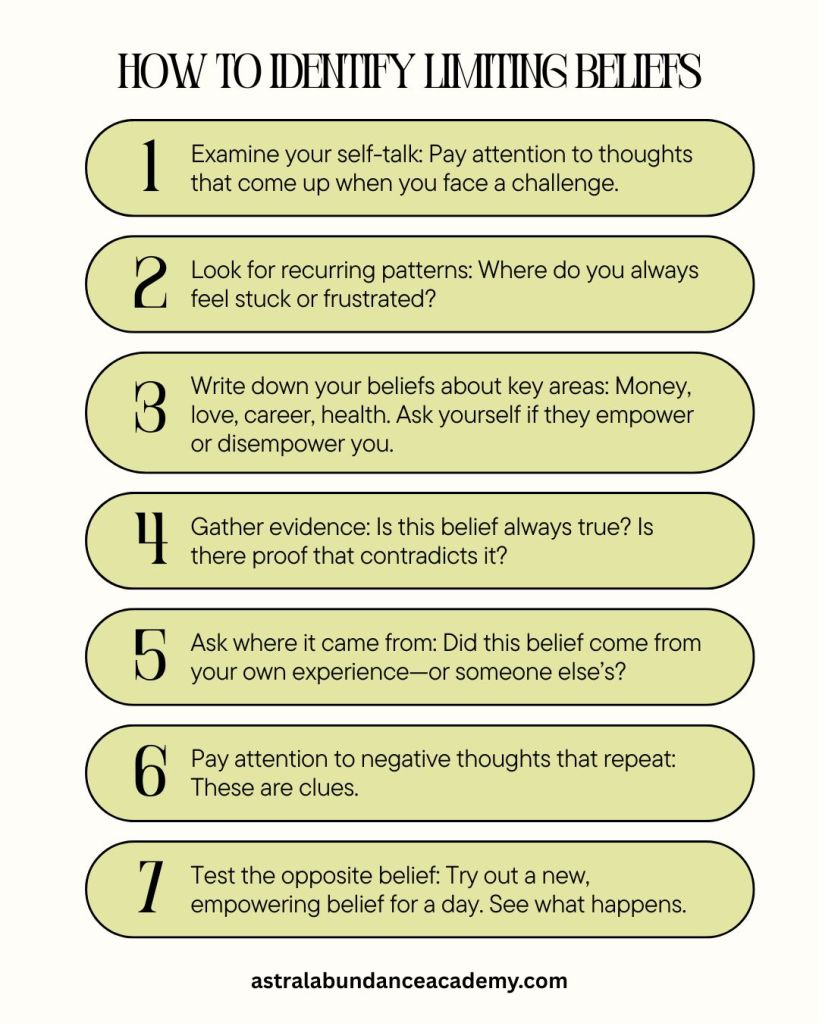
You can’t change what you’re not aware of. Here’s how to spot your own limiting beliefs:
- Examine your self-talk: Pay attention to thoughts that come up when you face a challenge.
- Look for recurring patterns: Where do you always feel stuck or frustrated?
- Write down your beliefs about key areas: Money, love, career, health. Ask yourself if they empower or disempower you.
- Gather evidence: Is this belief always true? Is there proof that contradicts it?
- Ask where it came from: Did this belief come from your own experience—or someone else’s?
- Pay attention to negative thoughts that repeat: These are clues.
- Test the opposite belief: Try out a new, empowering belief for a day. See what happens.
How to Overcome Limiting Beliefs (Step-by-Step)
You can’t just “think positive” and hope your beliefs change. You have to rewire your thinking and take aligned action.
Here’s how to eliminate limiting beliefs, backed by research and real-world tools:
1. Write Down Your Limiting Beliefs
If you’re trying to manifest something and it’s just not happening, chances are there’s a limiting belief blocking it.
It might not be obvious. That’s the tricky part—limiting beliefs often live under the surface.
You might consciously say, “I want more money,” but subconsciously believe, “I don’t deserve wealth” or “Rich people are greedy.”
When your beliefs don’t match your desires, you create inner resistance. That resistance stops your manifestation from coming through.
To break the cycle, start by identifying the beliefs that are standing in your way.
How to Do It
Set the mood for reflection. This isn’t just journaling—it’s self-discovery.
- Choose a quiet time when you won’t be interrupted
- Light a candle or incense
- Put on calming music or sit in silence
- Use a dedicated notebook just for mindset work
- Take a few deep breaths to ground yourself
Then ask yourself:
- “What do I believe about this thing I’m trying to manifest?”
- “What do I believe about myself when it comes to money/love/success?”
- “What did I learn growing up about this area of life?”

Let the answers flow freely. Don’t censor yourself.
Don’t worry about being “positive.” This is where you meet your inner blocks head-on.
Common limiting beliefs will pop up—like “I’m not good enough,” “It never works out for me,” or “I have to work hard to deserve anything.”
Write them all down. Give them space on the page.
Why It Works
Writing out your limiting beliefs brings the subconscious into the light.
A study by Lieberman et al. (2007) found that simply labeling emotions and thoughts reduces activity in the amygdala (the part of the brain responsible for fear and stress) and activates the prefrontal cortex, which helps with rational thinking and awareness.
When you name a belief, you take away its power. You stop reacting from it—and start observing it.
Naming the belief is the first step to changing it.
Once it’s on paper, it’s no longer running the show in your mind.
Source: Lieberman et al. (2007) – Study on affect labeling and emotional regulation
2. Question the Belief
Now that you’ve written down your limiting beliefs, it’s time to challenge them.
This is where the shift begins.
Just because you believe something doesn’t mean it’s true. Most limiting beliefs were never chosen consciously.
They came from a parent’s comment, a school experience, a rejection, or something you heard growing up.
You accepted it—and built your worldview around it.
But now? You get to question it.
How to Do It
Pick one belief you wrote down—especially one connected to the thing you’re trying to manifest.
Sit with it and ask:
- Is this always true? (Has there ever been a time it wasn’t true?)
- Where did I learn this? (Was it something I was told or something I decided?)
- What’s the real evidence for and against this? (Can I think of examples that disprove it?)
- Who would I be without this belief? (How would I think, feel, and act instead?)
Write your answers. This step isn’t about positive thinking—it’s about disrupting the story that’s been playing on repeat.
You might realize a belief came from a teacher who criticized you once, or a parent who said, “People like us don’t get rich.”
Suddenly, it makes sense why you’ve struggled to attract abundance—your mind was trying to protect you by staying in line with that old story.
Now you get to rewrite it.
Why It Works
This process mirrors what’s called cognitive restructuring, a core method used in Cognitive Behavioral Therapy (CBT).
Research shows that when people identify and challenge their distorted thinking, they’re able to reframe their beliefs and reduce negative patterns.
According to a study published on PubMed, restructuring beliefs leads to real changes in emotional responses and behavior.
In other words, when you question your beliefs, your brain starts building new connections—and that opens the door for change.
The goal isn’t to judge the belief. It’s to ask: Is this helping me get what I want?
If not—it’s time to let it go.
3. Replace It with an Empowering Belief
Once you’ve questioned your limiting belief, you’ve created space.
Now you need to fill that space with something new—something that aligns with the version of you who already has what you’re trying to manifest.
You’re not just getting rid of old beliefs. You’re installing new ones.
Beliefs are like mental habits. If you don’t replace the old habit, your brain will default back to it.
That’s why replacing limiting beliefs with empowering ones is essential.
How to Do It
Look back at the belief you just questioned.
Ask:
- “What do I want to believe instead?”
- “What belief would support me in manifesting my desire?”
- “What thought feels empowering and believable right now?”
Make sure the new belief:
- Supports the thing you want to manifest
- Uses positive, present-tense language
- Feels emotionally true, even if only a little
Examples:
- I’m not good enough. – I am learning and growing every day.
- Money is hard to come by. – I am open to receiving money in new ways.
- Love never lasts for me. – I am worthy of deep, lasting love.
- I always fail. – Every experience is helping me grow.
Write your new belief down clearly. Say it out loud. Repeat it. This is the version of you you’re stepping into.
Why It Works
This process taps into neuroplasticity—your brain’s ability to form new neural pathways.
According to studies by Draganski et al. (2004), when people repeat new mental patterns (like beliefs, affirmations, or visualizations), their brains physically change.
New connections are made. Old ones weaken.
It’s like updating your mental software. Over time, the new belief becomes your default.
“Neurons that fire together, wire together.” The more you think and act from a new belief, the stronger it becomes.
Sources:
4. Use Daily Affirmations
Now that you’ve created an empowering belief, it’s time to reinforce it.
Affirmations are how you reprogram your subconscious mind.
They take the new belief you want to install and repeat it until it becomes familiar—and eventually automatic.
This step is what turns belief into identity.
How to Do It
Take your new belief and turn it into a simple, present-tense affirmation. Start with “I am,” “I can,” or “I allow.”
Examples:
- “I am worthy of success.”
- “I allow abundance into my life with ease.”
- “I am open to receiving love and support.”
- “I trust myself to take aligned action.”
Write 1–3 affirmations that match your manifestation goals.
Then:
- Say them aloud every morning and every night
- Look yourself in the mirror while saying them for extra impact
- Write them out daily in a journal
- Record them and listen during your commute, walk, or meditation
- Add them to your phone’s lock screen or set daily reminders
The key is emotion + repetition. You’re not just reciting words—you’re training your brain to believe something new.
Why It Works
A 2015 study published in Social Cognitive and Affective Neuroscience found that self-affirmation activates the brain’s reward systems, especially the ventromedial prefrontal cortex.
This part of the brain is linked to decision-making, motivation, and behavior change.
In short, when you affirm a new belief with emotion, your brain lights up in ways that make you more open to change—and more likely to act on it.
This is how your subconscious mind starts to accept new instructions.
The more you repeat an empowering belief, the more real it becomes.
Sources:
- Falk et al. (2015) study on self-affirmation and brain reward
- Study overview on self-affirmation and future motivation
Pro tip: Want to supercharge your affirmations with manifestation?
Try the 55×5 manifestation method—a powerful technique where you write your affirmation 55 times a day for 5 days straight. It helps lock in the belief fast.
5. Visualize the New You
If affirmations are the words of a new belief, visualization is the movie.
When you close your eyes and picture yourself living from your new belief, you make it feel real.
Your subconscious doesn’t fully distinguish between real and imagined experiences—so the more vividly you imagine success, the more your mind believes it’s possible (and starts acting accordingly).
Visualization bridges the gap between who you’ve been and who you’re becoming.
How to Do It
Start with the empowering belief you created in Step 3.
Ask:
- “What would my life look like if this belief were already true?”
- “How would I think, feel, speak, and act?”
- “What would I be doing every day?”
- “Who would I be surrounded by?”
Then close your eyes and see it in detail:
- Picture yourself waking up confident, clear, and calm
- Imagine checking your bank account and feeling abundant
- Visualize your ideal partner looking at you with love and admiration
- Feel the emotion of living in alignment with this belief
Use all five senses. Involve your body. Smile as you do it.
You only need 2–5 minutes a day. The goal isn’t length—it’s intensity.
Why It Works
Visualization activates the same brain regions as actually performing the action.
A 2009 fMRI study by Guillot et al. in Neuropsychologia showed that mental imagery lights up the motor cortex and other brain areas responsible for movement and experience—meaning your brain gets “practice reps” even when you’re just imagining.
Other studies have linked visualization to higher self-efficacy (belief in your ability to succeed), increased performance, and better emotional regulation.
The more you mentally experience success, the easier it becomes to act like the person who has it.
Sources:
- Guillot et al. (2009) – Brain activity during visual vs. kinesthetic imagery
- Frontiers in Human Neuroscience – Mental imagery and brain activation
Pro tip: Combine this step with affirmations. Start by visualizing the desired version of you, then repeat your affirmation aloud while holding the vision in your mind.
This stacks belief, emotion, and mental imagery—supercharging your manifestation.
6. Take Aligned Action
This is where the magic becomes real.
You’ve uncovered the limiting belief. You’ve created a new one. You’ve visualized the version of yourself who already lives it.
Now it’s time to act like that version of you.
Why? Because beliefs shape behavior—and behavior reinforces belief.
When you take action from your new belief, even in small ways, you send a powerful message to your subconscious:
“This is who I am now.”
How to Do It
Ask yourself:
- “If I fully believed this, what would I do today?”
- “What’s one small action that aligns with my new belief?”
- “What would the ‘future me’ do next?”
Then do it.
Start small. Micro-actions count.
- New belief: “I am a confident communicator.”
→ Send that email, speak up once in a meeting, record a voice memo. - New belief: “I’m open to receiving abundance.”
→ Check your bank account with gratitude, apply for that opportunity, raise your rates. - New belief: “I am worthy of love.”
→ Set a boundary, go on a date, express your needs.
Every small action builds evidence.
You start to see yourself differently. The outside world starts responding differently too.
Why It Works
This step builds self-efficacy, which is your belief in your ability to create change.
According to psychologist Albert Bandura, self-efficacy increases when you experience mastery—even in small doses.
The more you act from a new belief, the more it becomes your reality. Your brain begins to hardwire the identity shift.
Studies show that self-efficacy plays a major role in motivation, resilience, and long-term success.
It’s the missing link between mindset and manifestation.
You don’t need to feel “ready.” You just need to move in the direction of your new belief.
Source:
Pro tip: Track your wins. At the end of the day, write down any actions you took that aligned with your new belief. This reinforces progress and gives your brain more proof to work with.
7. Surround Yourself with Positivity
You’ve done the inner work—now it’s time to protect it.
Your environment plays a huge role in whether your new beliefs stick or fade.
The people you talk to, the content you consume, the energy you’re around—it all either supports your new identity or pulls you back into old patterns.
If you’re serious about manifestation, you need to curate what surrounds you.
How to Do It
Look at your inputs. Start asking:
- Who do I spend the most time with? Do they uplift or drain me?
- What am I consuming online? Does it reinforce my worth or feed fear and comparison?
- Where do I feel most like my empowered self? How can I spend more time there?
Make small but intentional changes:
- Unfollow accounts that trigger self-doubt or scarcity
- Follow creators who talk about mindset, growth, and manifestation
- Spend more time around people who believe in you—or believe in themselves
- Read books, listen to podcasts, and watch content that reflects the beliefs you’re adopting
- Take breaks from environments (even digital ones) that reinforce your old identity
This isn’t about being “positive all the time.” It’s about aligning your outer world with the version of you you’re becoming.
Your environment should reflect your future, not your past.
Why It Works
According to Social Learning Theory (Bandura, 1977), we learn behaviors and beliefs by observing others.
The more you’re exposed to certain attitudes, actions, and emotional tones, the more likely you are to adopt them—consciously or not.
Surrounding yourself with positive, empowered, and growth-minded influences doesn’t just feel good—it reshapes your belief system over time.
Studies show that social support increases motivation, lowers stress, and strengthens your ability to maintain new habits and perspectives.
Sources:
- Bandura’s Social Learning Theory – Structural Learning Summary
- ResearchGate overview on Bandura’s theory
Pro tip: If you don’t have positive influences in your real life yet, create a “virtual environment.” Curate your YouTube, podcast, or TikTok feed to be full of people who speak, act, and live in alignment with the beliefs you’re working toward.
Conclusion: Overcome Your Limiting Beliefs & Manifest Your Dreams
Limiting beliefs aren’t facts. They’re just thoughts you’ve repeated for so long that they feel true.
But you’re not stuck with them.
You now have the tools to identify, challenge, and replace the beliefs that have been blocking your manifestations. You’ve learned how to:
- Recognize limiting beliefs when things aren’t working
- Question the stories you’ve been telling yourself
- Create empowering beliefs that support your goals
- Reinforce those beliefs through affirmations, visualization, and action
- Build an environment that helps your new beliefs stick
This work isn’t about being perfect. It’s about being intentional.
Every time you choose a new belief, take an aligned action, or repeat a powerful affirmation—you’re rewiring your mind and reshaping your reality.
You are not your old stories. You are the creator of your future.
Want more tools like this delivered to your inbox?
Join the Astral Abundance Academy newsletter for weekly manifestation tips, belief work prompts, and techniques to help you align your mind with your desires.
Subscribe now to get your FREE copy of “Manifestation Made Simple” – our essential guide to manifest the life of your dreams.
You’re closer than you think. Keep going.

 Astral Abundance Academy
Leave a comment